
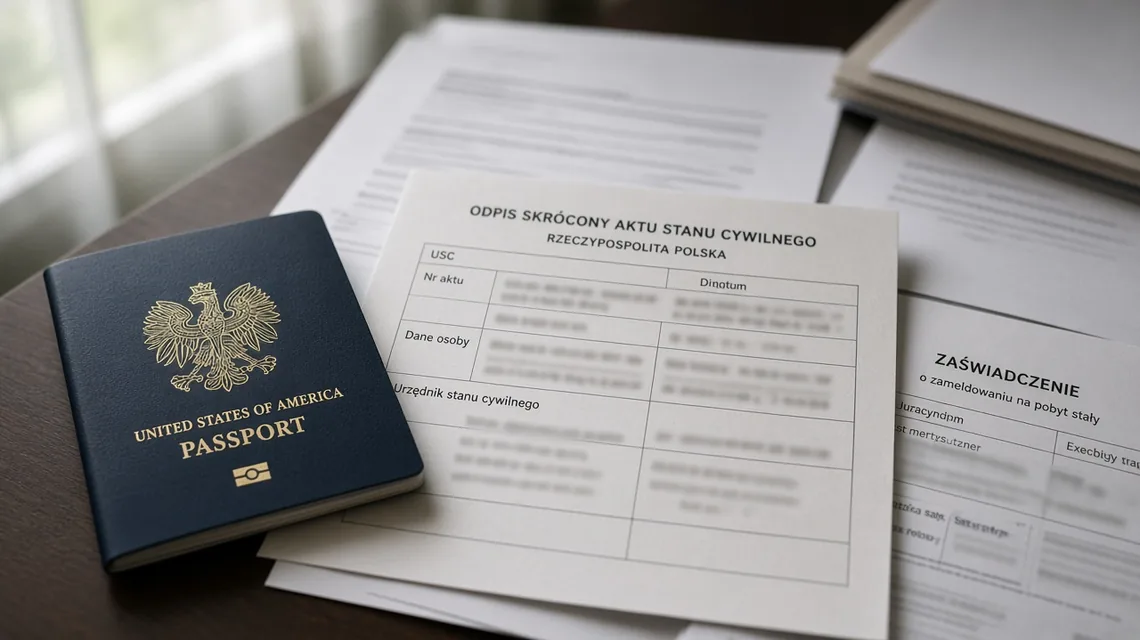
USCIS accepts foreign-language documents only with a full English translation. Separately, the translator must certify that the translation is complete and accurate and that the translator is competent to perform it. That standard does not automatically match a Polish sworn translation.
Applicants often confuse English certified translation, a Polish sworn seal for local authorities, and notarial acts. USCIS usually does not require a notary for the translation itself; apostille concerns source-document authenticity, not linguistic certification.
This article explains what USCIS checks, how certified translation differs from Polish sworn work, common document types, and typical mistakes. Order via the USCIS certified translation page; we do not change its H1.
USCIS expects a full English text plus a signed translator statement on completeness, accuracy, and competence. Polish sworn status alone does not replace that format if the output is not English or the certification wording is wrong.
01What USCIS expects from a translation
Non-English documents need a full English translation including stamps, seals, signatures, marginal notes, and attachments that are part of the record.
- The translator provides certification of translation: completeness, accuracy, and competence to translate from the source language into English (in the spirit of 8 CFR 103.2(b)(3), described here without linking the rule text).
- The foreign original or copy is filed with the translation when the form instructions require it.
- USCIS evaluates English content and proper attestation, not only professional status in another country.
- Common items: birth and marriage certificates, police certificates, diplomas, court orders — usually one full translation and certification per document unless the form allows bundling.
02USCIS versus Polish sworn translation
03Certification of translation wording
Include translator identification, completeness, accuracy, competence, date, and signature.
“True translation” alone may fail if completeness and competence are missing — use counsel’s sample.
Agencies may sign through a responsible linguist; USCIS focuses on attestation content.
Link certification clearly to the translation pages.
Applicant self-certification is not acceptable; family translations without attestation often trigger RFEs.
Before ordering, ask counsel or check the form checklist: English language, full translation of seals, and the exact certification of translation wording.
Send your USCIS document list
We confirm certified-translation format and completeness.
04Documents translated most often
- Vital records: every field, registry stamps, apostille on the same sheet.
- Passports and certificates: all pages including endorsements on the reverse.
- Diplomas and transcripts: every page; summaries do not replace required documents.
- Court orders and contracts: preserve structure and exact identifiers.
- Confirm with counsel whether one attestation covers a multi-document packet.
05Apostille, notary, and translation certification
Do not order a “notarial translation for USCIS” without a written checklist from counsel or the form instructions. A notary does not replace translator certification; apostille is not a translation.
- Apostille authenticates the public source document; it is not English translation.
- For Hague countries, apostille often comes first, then English translation including the apostille page if attached.
- USCIS usually does not require notarisation of the translation.
- That sequence avoids redoing English text after a new stamp is added.
- Show the final carrier to the bureau before quoting deadlines.
06How to order without extra steps
Build the document list from your form checklist (I-130, I-485, N-400, etc.).
Send full-color scans without cropping seals; agree Latin spellings of names.
Request a certification sample and timeline; confirm PDF versus paper with counsel.
Use USCIS certified translation for immigration packets; certified translation covers other recipients.
Counsel matches translation to source before filing; LEGIX delivers translation and certification.
07Mistakes that force a new translation
- Self-translation without attestation.
- Missing stamps or reverse-side text.
- Polish sworn only — no English deliverable.
- Mixing notarial acts with translator certification.
- Name or date mismatches.
- Stale translation after the source document was replaced.
QuoteUSCIS looks at two layers: readable English text and the translator’s signed completeness and accuracy statement. A sworn seal for a Polish authority serves a different purpose.
LEGIX Team
Need certified translation for USCIS?
We align English translation, certification and timing.
08FAQ
USCIS requires English translation with translator certification. A sworn translator may do it if the output is English with proper certification.