


1. When is sworn translation required for citizenship?
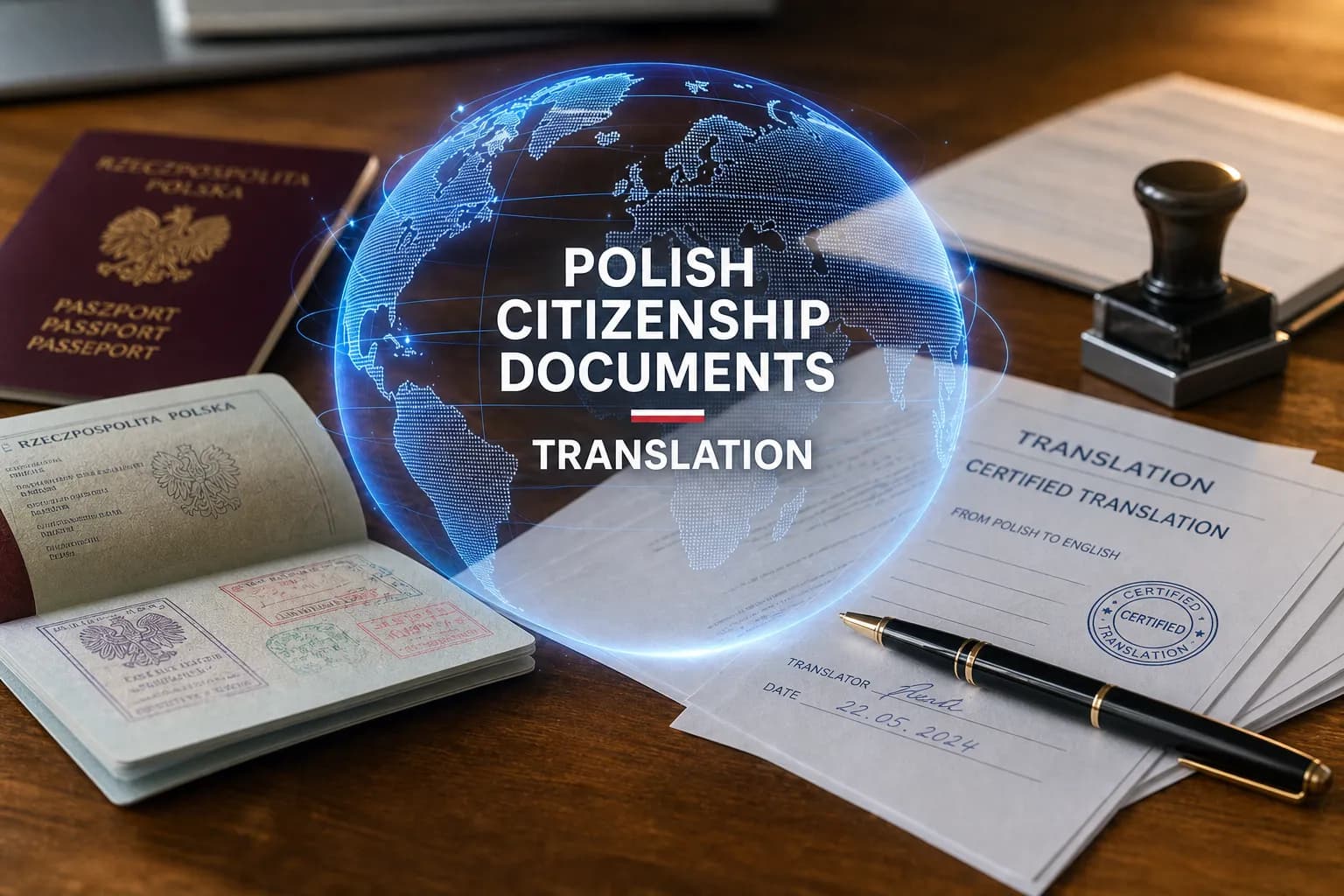
Translation is required for any document not issued in Polish that you attach to an application for Polish citizenship at the voivodeship office.
Translation is required for:
- By descent: civil status acts of parents or ancestors — birth, marriage, name change certificates — if they prove Polish roots.
- By marriage to a Polish citizen: marriage certificate, documents on previous marriages and divorces, sometimes spouses' birth certificates.
- By long-term residence: proof of legal stay, income, Polish language knowledge (B1 certificate), integration — all foreign certificates require sworn translation.
- Criminal record certificate: from country of citizenship and from each country where you lived over one year after age 14 — full translation with apostille if required.
- Diploma and employment history: if the office requests proof of education or service — diploma, transcript, employment certificates are translated in full.
- Children's documents: birth certificates of minors included in the parent's application — sworn translation into Polish.
Important!
2. Which documents are translated for citizenship
Before ordering translation, use the table below — it shows which certificate you need, whether apostille is required, and what to verify before sending scans. Save it — when preparing an office submission, checking line by line is safer than relying on memory.
The exact set depends on the legal basis — check the table and confirm the list with the voivodeship office before ordering translation.
| Civil status acts | birth, marriage, divorce, spouse's death, name change certificates — full translation of all pages, including apostille. |
|---|---|
| Passport and identity documents | data pages, visas, border stamps — if the office requires translation (confirm in advance). |
| Proof of legal stay | residence cards, asylum decisions, registration documents — if not in Polish. |
| Income and employment | income certificates, tax returns, employment contracts, pension documents — for bases requiring financial stability. |
| Language certificate | if the exam was taken outside Poland and the certificate is not in Polish — sworn translation is required. |
| Order | apostille or legalisation in the issuing country first, then sworn translation. Language pair — source language → Polish, translator from the Ministry of Justice register. |
3. Voivodeship office translation requirements
The voivodeship office accepts only sworn translation into Polish with the seal and signature of a translator from the Polish Ministry of Justice register.
- Without full translation of all pages — including stamps, seals, apostille and reverse sides — the package may be returned even if the content is correct.
- Completeness: every page of the original is translated — summaries, abbreviations and selective translation are not accepted.
- Data accuracy: names, dates, places and document numbers must match across all acts, translations and the passport.
Note
4. What happens if the translation is incorrect?
- Package return: the voivodeship office will not accept the application — you will need to reassemble the file and lose your place in the queue.
- Years of delay: the citizenship case may be suspended until a correct sworn translation is provided for each problematic document.
- Extra costs: re-translation, new certificates from abroad, apostille, courier delivery and missed document validity deadlines.
5. Step-by-step guide
Obtain a written document list from the voivodeship office or lawyer for your legal basis — descent, marriage or long-term residence.
Order originals or certified copies of acts in the issuing countries. For EU acts check whether the office accepts the multilingual form without translation.
Affix apostille or legalisation on foreign documents — before ordering sworn translation so the clause is included in the text.
Make clear scans of all pages: text, stamps and signatures readable. PDF or JPG, resolution at least 300 dpi.
Send scans to a translation agency — after review they confirm cost and turnaround. At LEGIX we match a translator from the Ministry of Justice register for the correct language pair.
Receive finished sworn translations with seal — by courier across Poland or in person.
Before submission verify all data in translations against originals and passport; check the seal on every page.
6. Cost and turnaround for citizenship translation
Cost depends on document volume, source language and number of papers in the package. Exact pricing is confirmed after reviewing scans — indicative rates on the price list.
A typical birth or marriage certificate is 1–2 translation pages; a diploma with transcript or multi-page employment history costs more.
Standard turnaround for one document is 24–48 hours after order confirmation. Plan 1–3 weeks for a package of 8–15 citizenship documents.
Pre-submission checklist