
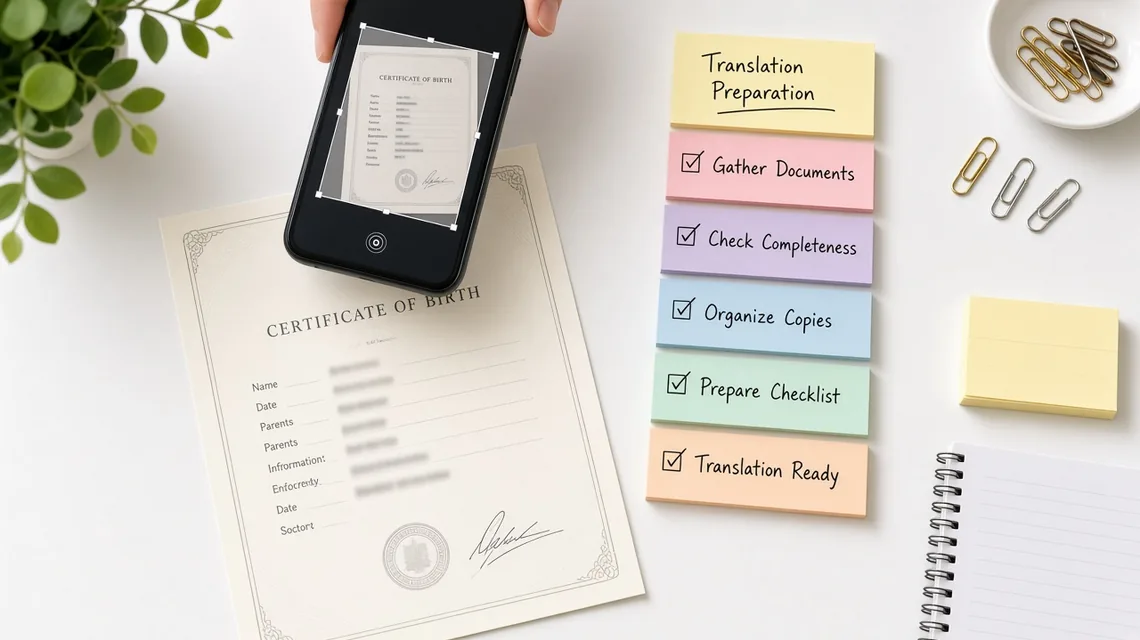
Preparing a translation starts with the receiving institution’s requirements, not with a scanner. The same diploma, certificate or record may need to be submitted in full or with an attachment, with or without an apostille, on paper or electronically.
This is a pre-order checklist: what to collect, which pages to capture, when to obtain an apostille, how to align name spelling and when the original is required. A separate article about sworn translation online covers the ordering process that follows.
Complete the list before asking for a price. A full readable package lets the bureau assess volume immediately and avoids interruptions caused by a missing reverse, an outdated certificate or an attachment discovered later.
First obtain the recipient’s list, then check validity and the legalisation sequence, collect every page and only then scan. A price and deadline are reliable only when the bureau sees the same package you intend to submit.
011. Start with the receiving institution’s list
Request written instructions instead of copying someone else’s package. A university, employer, court, bank and Polish public authority may set different rules even for documents with the same title.
Mark the result and keep the recipient’s written confirmation so the bureau can quote the correct output.
Check before sending. If unclear, ask the recipient one precise question and attach the answer.
Compare the package with the passport, then enlarge the file: text, numbers and seals must remain readable.
Name the file clearly and identify its person and procedure, especially in a family order.
Mark the result and keep the recipient’s written confirmation so the bureau can quote the correct output.
Check before sending. If unclear, ask the recipient one precise question and attach the answer.
022. Check issue dates and validity windows
A translation itself does not usually expire; the restriction more often applies to the source certificate. Recipients frequently want criminal-record, civil-status, income or bank documents to be recent, usually within three to six months, but this is common practice rather than one universal law.
033. Set the apostille, legalisation and translation order
Do not obtain an apostille or order translation just in case. Confirm whether legalisation is required, which document it applies to and whether the apostille itself must be translated. The sequence depends on the issuing country and intended use.
- Confirm whether this procedure requires an apostille.
- Identify the competent authority and document.
- Ask whether the apostille must be translated.
- Do not laminate or alter the document first.
- Scan the package again after the apostille is added.
- Send every sheet and attachment forming the certificate.
044. Make a readable scan or photograph
Use a 300 dpi colour scan saved as PDF as a practical quality target, not as a universal legal rule. A phone photograph is suitable for quoting if the camera is directly above the page, lighting is even and automatic cropping has preserved every edge.
A translator describes seals, signatures, handwriting and illegible fragments. Filters can erase a faint seal, so send an honest image and identify the difficult area separately.
- Show all four corners and a small margin.
- Capture the front and back of each sheet.
- Check focus on small numbers and seal text.
- Remove glare, shadows, fingers and spine distortion.
- Save pages in one correctly ordered PDF.
- Avoid screenshots and heavily compressed messenger files.
Send the documents before ordering
We will check completeness and file quality, then confirm format, price and timing.
055. Align name spelling with the passport
Consistency across the package matters. One surname may have several Latin-script forms because of different transliteration systems, replacement documents or historic records. Never edit the source yourself; flag the discrepancy before work begins.
- Copy the name exactly from the current passport.
- Check middle names, hyphens and diacritics.
- Compare spelling for parents, spouses and children.
- Attach an earlier translation for a continuing case.
- Report a surname change and add the supporting record.
- Never ask to conceal an error in the source.
066. Decide when the original is required
077. Organise family and multi-document orders
Organise a large order by person and procedure rather than file type. Create a folder for each applicant, include the recipient’s requirements and add one overall index. This prevents a child’s certificate being assigned to a parent with the same surname.
- Create one folder for each family member.
- Name files surname-document-page.
- Add a short contents list to every folder.
- Mark records shared by two applicants.
- State paper-copy quantities for each procedure.
- Nominate one contact for package-wide questions.
088. Preparation mistakes that delay an order
Work most often stops because the source is incomplete: a reverse, attachment or apostille page is missing, or glare hides a seal. A second group of delays comes from requirements discovered only after translation begins.
- Do not send only the page that looks important.
- Do not crop edges for a prettier picture.
- Do not translate before resolving apostille order.
- Do not mix several people’s documents without labels.
- Do not calculate timing from an incomplete file.
- Do not promise an output the recipient has not confirmed.
QuoteThe best file for a quote is not the prettiest one but the complete one: every side, edge, seal, signature, attachment and a clear indication of its owner.
LEGIX Team
Send the documents before ordering
We will check completeness and file quality, then confirm format, price and timing.
09FAQ
Use a 300 dpi colour PDF as a practical target, with readable edges, small text, signatures and seals. It is not one universal legal rule. A careful phone photograph can also be sufficient for quoting.