
local_shippingOnline order from scan — free delivery across Poland
🇺🇸 US market · USCISManager online in Telegram and WhatsAppMon–Fri 9:00–18:00
local_shippingManager online in Telegram and WhatsApp
Sworn translation

How to get a sworn translation quickly

“How quickly” for a sworn translation is not about an “order online” button and not about what the package includes. It is about the calendar: when working days start counting, how standard differs from express, what actually delays release, and when an urgency surcharge does not move the date in your hands.

Topic
Sworn translation
Time
14 min
Date
21 Oct 2026
Updated
21 Oct 2026
Legix editorial
LEGIX
Share
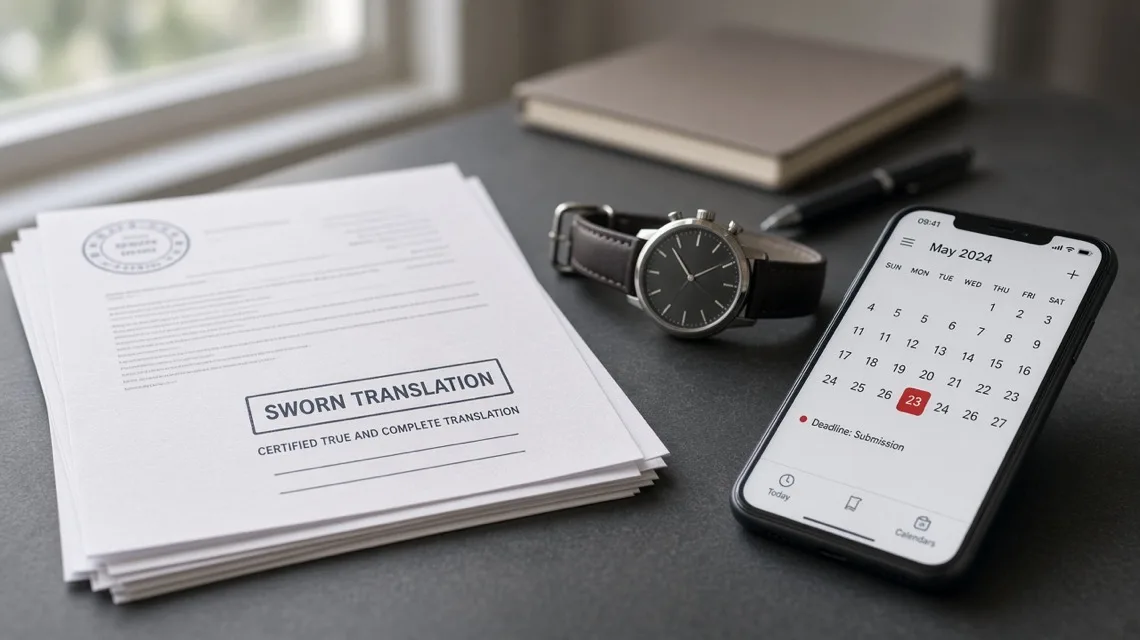
Clock and documents: sworn translation turnaround and express
In brief
The essentials in 30 seconds

Sworn translation timing is counted in working days after a confirmed order and a readable scan — not from the first chat message. Standard is usually 1–3 or 2–5 working days; express is often 24–48 hours or same day for short documents. Weekends and Polish public holidays (including Wigilia on 24 December) do not count; a PDF with QES is available on the day of completion, while paper with courier often adds about one working day.

“How quickly” for a sworn translation is not about an “order online” button and not about what the package includes. It is about the calendar: when working days start counting, how standard differs from express, what actually delays release, and when an urgency surcharge does not move the date in your hands.

On the Polish market, standard often fits in 1–3 or 2–5 working days depending on the bureau, volume and language. Express is usually promised in 24–48 hours or same day for short documents — almost always with a surcharge. Exact amounts belong on the price list; here we cover timing logic without invented fees.

A separate guide on ordering online explains the channel and submission steps. This article focuses elsewhere: what to send so the clock starts today, PDF with a qualified electronic signature versus paper with courier, rare languages, holidays, and when express is useless — for example while apostille is pending or the scan is unreadable. Order via the sworn translation page.

Definition
Sworn translation turnaround

Sworn translation timing is counted in working days after a confirmed order and a readable scan — not from the first chat message. Standard is usually 1–3 or 2–5 working days; express is often 24–48 hours or same day for short documents. Weekends and Polish public holidays (including Wigilia on 24 December) do not count; a PDF with QES is available on the day of completion, while paper with courier often adds about one working day.

01Timing modes: standard, accelerated, express

Bureaux usually name three corridors. Standard is the base mode without an urgency surcharge: in practice often 1–3 working days for short typical documents, or 2–5 working days when volume is larger, the language less common or several orders are queued. Accelerated sits between them — closer to one or two working days. Express is 24–48 hours or release on the same working day for short texts, almost always with a surcharge.

ModeTypical timingWhen it fits
Standard
Often 1–3 or 2–5 working days — depends on the bureau, volume and language
Typical certificates and passports without urgency; see the price list for orientation, not a fixed fee
Accelerated
Usually between standard and express: closer to 1–2 working days for short volume
When the deadline is tight but not “today by evening”
Express / same day
Often 24–48 hours or same day for short documents; a surcharge is common
Only if the scan is readable, the language is available and there is no upstream chain (apostille)
  • A “working day” is not calendar time from the first message.
  • Volume is billed in 1,125-character pages of finished text.
  • An urgency surcharge is common on the market, but the amount depends on the bureau and the file.
  • Mode does not replace agreeing language, delivery format and number of copies.

02When the clock starts: confirmation and a readable scan

01
The clock starts only when both are true: the bureau has confirmed the order in writing (scope, language, mode, delivery format) and the translator has a readable scan or an agreed source medium.

The clock starts only when both are true: the bureau has confirmed the order in writing (scope, language, mode, delivery format) and the translator has a readable scan or an agreed source medium. “How much and how fast?” without a file is not a start.

02
Readable means every side and the reverse, uncropped edges, distinguishable seals and handwriting, annexes present.

Readable means every side and the reverse, uncropped edges, distinguishable seals and handwriting, annexes present. A blurry phone photo is often returned — and the deadline shifts to the moment a proper file arrives.

03
Late evening and night: confirmation after bureau working hours usually rolls to the next working morning.

Late evening and night: confirmation after bureau working hours usually rolls to the next working morning. If you were promised “today”, ask for the express intake cut-off hour.

04
Payment and start: some bureaux begin after prepayment, others after volume confirmation.

Payment and start: some bureaux begin after prepayment, others after volume confirmation. Ask the rule before choosing express so you do not count hours from “I already wrote”.

05
Changing the brief after start (another language, extra pages, paper instead of PDF) pauses or recalculates the deadline.

Changing the brief after start (another language, extra pages, paper instead of PDF) pauses or recalculates the deadline. Lock scope before the clock runs.

Practical tip

For the clock to start today, send a readable scan of every side, confirm language and delivery format (PDF with QES or paper), and wait for written order confirmation — do not confuse a first inquiry with the start of the clock.

Timing check

Send a scan — we will give a realistic deadline

We factor volume, language, delivery format and whether work can start today.

TelegramWhatsApp

03What delays release

  • Incomplete package: missing reverse, apostille sticker, contract annex or a page with a seal.
  • Rare languages and rare language pairs: even express depends on a sworn translator with the right authorisation.
  • Large volume: multi-page contracts, NDAs, court materials.
  • Weekends and Polish public holidays do not count as working days.
  • Terminology clarifications, glossary approval for a company, waiting for the client’s reply on an unreadable fragment — all are pauses outside “pure” translation time.
  • Upstream chain: apostille or legalisation before translation.

04PDF with QES or paper with courier

Delivery format changes the date “in your hands” even when the translation is already finished. An electronic original is a PDF signed with the sworn translator’s qualified electronic signature (QES). That file can usually be sent on the day the translation is ready — without physical logistics.

  • A paper original needs a seal, signature and often stitching.
  • A scan of a paper translation is fine for archive but is not an electronic original with QES.
  • Sometimes both formats are needed: PDF for a portal and paper for an in-person visit.
  • International paper delivery takes longer than domestic.

05When express helps — and when it is useless

When express will not help

Express does not speed up an external chain: apostille and legalisation before translation, waiting for a rare language, an unreadable photo or a missing page. If the bottleneck is outside the bureau, an urgency surcharge barely moves the date in your hands. Close scans and upstream steps first, then choose a mode.

  • Express fits when the scan is complete and readable, language and direction are available, volume is short, delivery format is agreed (preferably PDF with QES) and you are not waiting on apostille or a third-party reply.
  • Express is useless if the file is unreadable: you need a proper scan first.
  • Express is useless while apostille or legalisation is open: the bottleneck is the authority or consular chain, not typing speed.
  • Express is weak for a rare language in peak season: if the translator is busy, a surcharge does not create a free slot.
  • Express does not cancel holidays and weekends: “48 hours” across Wigilia and New Year are different calendar days than 48 working hours mid-week.
  • If the recipient still waits two days for courier paper, paying for same-day translation saves little — choose PDF or standard plus clear delivery.

06How to speed up: what to send so the clock starts today

  • One PDF or a set of sharp photos: front and reverse, all annexes, apostille on the same pack if it already exists.
  • In the request state upfront: source and target languages, mode (standard / accelerated / express), delivery format (PDF with QES / paper / both), pickup city or courier address, number of copies.
  • Give a calendar filing deadline at the authority — not only “urgent”.
  • Close upstream before ordering translation if apostille must come first.
  • Answer the translator’s clarifications the same working day: an unanswered question on an unreadable line pauses the deadline.
  • For B2B, attach a glossary or a sample of past company translations upfront — fewer terminology loops.
  • Do not confuse this checklist with “how to order online”: the submission channel is in a separate article; here it is the package content that starts the clock.

07Timing calculation mistakes

  • Counting the deadline from the first messenger message instead of order confirmation and scan.
  • Confusing calendar days with working days and forgetting Polish holidays, including Wigilia on 24 December.
  • Paying for express with an unreadable file or missing page — and expecting the date not to move.
  • Promising yourself same day on a long contract: 1,125-character page volume does not vanish with a surcharge.
  • Forgetting that paper with courier is a separate day after the translation is ready.
  • Choosing express while apostille is “still in progress”: the translation waits in vain and the urgency budget is already spent.
  • Comparing only urgency price without asking “from which hour / which day do you count”.
Quote

A fast translation is not “today at any cost” — it is the match of a readable file, an available translator and a delivery format. Express without those three conditions is only more expensive, not faster.

LEGIX team
Summary
How to get it faster
The clock runs after a confirmed order and a readable scan
Standard is often 1–3 or 2–5 working days; express is often 24–48h or same day for short docs
Weekends and Polish public holidays (including Wigilia Dec 24) are not working days
PDF with QES is ready on the day of completion; paper + courier often adds ~1 working day
Express does not speed up apostille or an unreadable file
Order

Need a sworn translation on time?

We align mode, PDF or paper and the release date before payment.

TelegramWhatsApp

08FAQ

On the market, standard is often 1–3 or 2–5 working days depending on the bureau, volume and language. Express is usually 24–48 hours or same day for short documents, almost always with a surcharge. An exact date comes from a quote on your scan; price orientation is on the price list.

local_shippingOnline order from scan — free delivery across Poland
🇺🇸 US market · USCISManager online in Telegram and WhatsAppMon–Fri 9:00–18:00
local_shippingManager online in Telegram and WhatsApp
Sworn translation

How to get a sworn translation quickly

“How quickly” for a sworn translation is not about an “order online” button and not about what the package includes. It is about the calendar: when working days start counting, how standard differs from express, what actually delays release, and when an urgency surcharge does not move the date in your hands.

Clock and documents: sworn translation turnaround and express
TopicSworn translation
Time14 min
Date21 Oct 2026
Legix editorial
LEGIX
In brief
The essentials in 30 seconds

Sworn translation timing is counted in working days after a confirmed order and a readable scan — not from the first chat message. Standard is usually 1–3 or 2–5 working days; express is often 24–48 hours or same day for short documents. Weekends and Polish public holidays (including Wigilia on 24 December) do not count; a PDF with QES is available on the day of completion, while paper with courier often adds about one working day.

“How quickly” for a sworn translation is not about an “order online” button and not about what the package includes. It is about the calendar: when working days start counting, how standard differs from express, what actually delays release, and when an urgency surcharge does not move the date in your hands.

On the Polish market, standard often fits in 1–3 or 2–5 working days depending on the bureau, volume and language. Express is usually promised in 24–48 hours or same day for short documents — almost always with a surcharge. Exact amounts belong on the price list; here we cover timing logic without invented fees.

A separate guide on ordering online explains the channel and submission steps. This article focuses elsewhere: what to send so the clock starts today, PDF with a qualified electronic signature versus paper with courier, rare languages, holidays, and when express is useless — for example while apostille is pending or the scan is unreadable. Order via the sworn translation page.

Definition
Sworn translation turnaround

Sworn translation timing is counted in working days after a confirmed order and a readable scan — not from the first chat message. Standard is usually 1–3 or 2–5 working days; express is often 24–48 hours or same day for short documents. Weekends and Polish public holidays (including Wigilia on 24 December) do not count; a PDF with QES is available on the day of completion, while paper with courier often adds about one working day.

01Timing modes: standard, accelerated, express

Bureaux usually name three corridors. Standard is the base mode without an urgency surcharge: in practice often 1–3 working days for short typical documents, or 2–5 working days when volume is larger, the language less common or several orders are queued. Accelerated sits between them — closer to one or two working days. Express is 24–48 hours or release on the same working day for short texts, almost always with a surcharge.

ModeTypical timingWhen it fits
Standard
Often 1–3 or 2–5 working days — depends on the bureau, volume and language
Typical certificates and passports without urgency; see the price list for orientation, not a fixed fee
Accelerated
Usually between standard and express: closer to 1–2 working days for short volume
When the deadline is tight but not “today by evening”
Express / same day
Often 24–48 hours or same day for short documents; a surcharge is common
Only if the scan is readable, the language is available and there is no upstream chain (apostille)
  • A “working day” is not calendar time from the first message.
  • Volume is billed in 1,125-character pages of finished text.
  • An urgency surcharge is common on the market, but the amount depends on the bureau and the file.
  • Mode does not replace agreeing language, delivery format and number of copies.

02When the clock starts: confirmation and a readable scan

01
The clock starts only when both are true: the bureau has confirmed the order in writing (scope, language, mode, delivery format) and the translator has a readable scan or an agreed source medium.

The clock starts only when both are true: the bureau has confirmed the order in writing (scope, language, mode, delivery format) and the translator has a readable scan or an agreed source medium. “How much and how fast?” without a file is not a start.

02
Readable means every side and the reverse, uncropped edges, distinguishable seals and handwriting, annexes present.

Readable means every side and the reverse, uncropped edges, distinguishable seals and handwriting, annexes present. A blurry phone photo is often returned — and the deadline shifts to the moment a proper file arrives.

03
Late evening and night: confirmation after bureau working hours usually rolls to the next working morning.

Late evening and night: confirmation after bureau working hours usually rolls to the next working morning. If you were promised “today”, ask for the express intake cut-off hour.

04
Payment and start: some bureaux begin after prepayment, others after volume confirmation.

Payment and start: some bureaux begin after prepayment, others after volume confirmation. Ask the rule before choosing express so you do not count hours from “I already wrote”.

05
Changing the brief after start (another language, extra pages, paper instead of PDF) pauses or recalculates the deadline.

Changing the brief after start (another language, extra pages, paper instead of PDF) pauses or recalculates the deadline. Lock scope before the clock runs.

Practical tip

For the clock to start today, send a readable scan of every side, confirm language and delivery format (PDF with QES or paper), and wait for written order confirmation — do not confuse a first inquiry with the start of the clock.

Timing check

Send a scan — we will give a realistic deadline

We factor volume, language, delivery format and whether work can start today.

TelegramWhatsApp

03What delays release

  • Incomplete package: missing reverse, apostille sticker, contract annex or a page with a seal.
  • Rare languages and rare language pairs: even express depends on a sworn translator with the right authorisation.
  • Large volume: multi-page contracts, NDAs, court materials.
  • Weekends and Polish public holidays do not count as working days.
  • Terminology clarifications, glossary approval for a company, waiting for the client’s reply on an unreadable fragment — all are pauses outside “pure” translation time.
  • Upstream chain: apostille or legalisation before translation.

04PDF with QES or paper with courier

Delivery format changes the date “in your hands” even when the translation is already finished. An electronic original is a PDF signed with the sworn translator’s qualified electronic signature (QES). That file can usually be sent on the day the translation is ready — without physical logistics.

  • A paper original needs a seal, signature and often stitching.
  • A scan of a paper translation is fine for archive but is not an electronic original with QES.
  • Sometimes both formats are needed: PDF for a portal and paper for an in-person visit.
  • International paper delivery takes longer than domestic.

05When express helps — and when it is useless

When express will not help

Express does not speed up an external chain: apostille and legalisation before translation, waiting for a rare language, an unreadable photo or a missing page. If the bottleneck is outside the bureau, an urgency surcharge barely moves the date in your hands. Close scans and upstream steps first, then choose a mode.

  • Express fits when the scan is complete and readable, language and direction are available, volume is short, delivery format is agreed (preferably PDF with QES) and you are not waiting on apostille or a third-party reply.
  • Express is useless if the file is unreadable: you need a proper scan first.
  • Express is useless while apostille or legalisation is open: the bottleneck is the authority or consular chain, not typing speed.
  • Express is weak for a rare language in peak season: if the translator is busy, a surcharge does not create a free slot.
  • Express does not cancel holidays and weekends: “48 hours” across Wigilia and New Year are different calendar days than 48 working hours mid-week.
  • If the recipient still waits two days for courier paper, paying for same-day translation saves little — choose PDF or standard plus clear delivery.

06How to speed up: what to send so the clock starts today

  • One PDF or a set of sharp photos: front and reverse, all annexes, apostille on the same pack if it already exists.
  • In the request state upfront: source and target languages, mode (standard / accelerated / express), delivery format (PDF with QES / paper / both), pickup city or courier address, number of copies.
  • Give a calendar filing deadline at the authority — not only “urgent”.
  • Close upstream before ordering translation if apostille must come first.
  • Answer the translator’s clarifications the same working day: an unanswered question on an unreadable line pauses the deadline.
  • For B2B, attach a glossary or a sample of past company translations upfront — fewer terminology loops.
  • Do not confuse this checklist with “how to order online”: the submission channel is in a separate article; here it is the package content that starts the clock.

07Timing calculation mistakes

  • Counting the deadline from the first messenger message instead of order confirmation and scan.
  • Confusing calendar days with working days and forgetting Polish holidays, including Wigilia on 24 December.
  • Paying for express with an unreadable file or missing page — and expecting the date not to move.
  • Promising yourself same day on a long contract: 1,125-character page volume does not vanish with a surcharge.
  • Forgetting that paper with courier is a separate day after the translation is ready.
  • Choosing express while apostille is “still in progress”: the translation waits in vain and the urgency budget is already spent.
  • Comparing only urgency price without asking “from which hour / which day do you count”.
Quote

A fast translation is not “today at any cost” — it is the match of a readable file, an available translator and a delivery format. Express without those three conditions is only more expensive, not faster.

LEGIX team
Summary
How to get it faster
The clock runs after a confirmed order and a readable scan
Standard is often 1–3 or 2–5 working days; express is often 24–48h or same day for short docs
Weekends and Polish public holidays (including Wigilia Dec 24) are not working days
PDF with QES is ready on the day of completion; paper + courier often adds ~1 working day
Express does not speed up apostille or an unreadable file
Order

Need a sworn translation on time?

We align mode, PDF or paper and the release date before payment.

TelegramWhatsApp

08FAQ

On the market, standard is often 1–3 or 2–5 working days depending on the bureau, volume and language. Express is usually 24–48 hours or same day for short documents, almost always with a surcharge. An exact date comes from a quote on your scan; price orientation is on the price list.